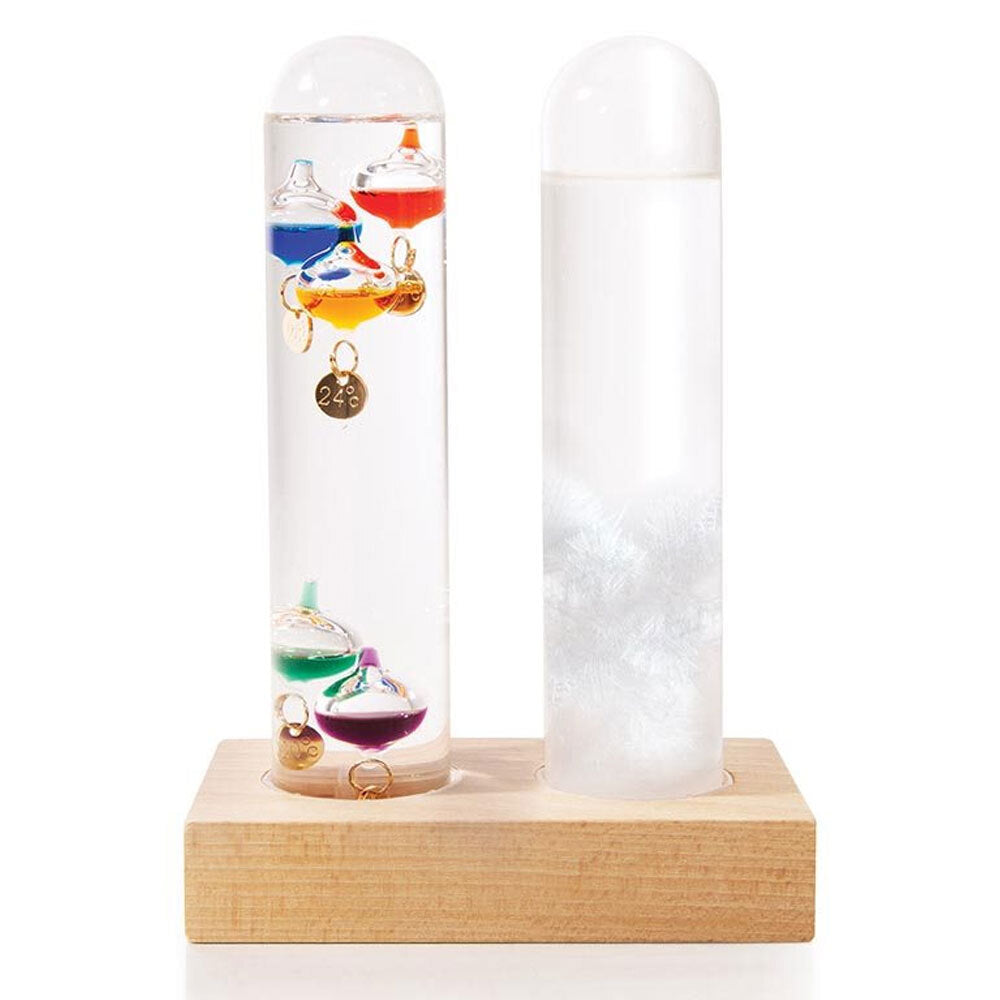
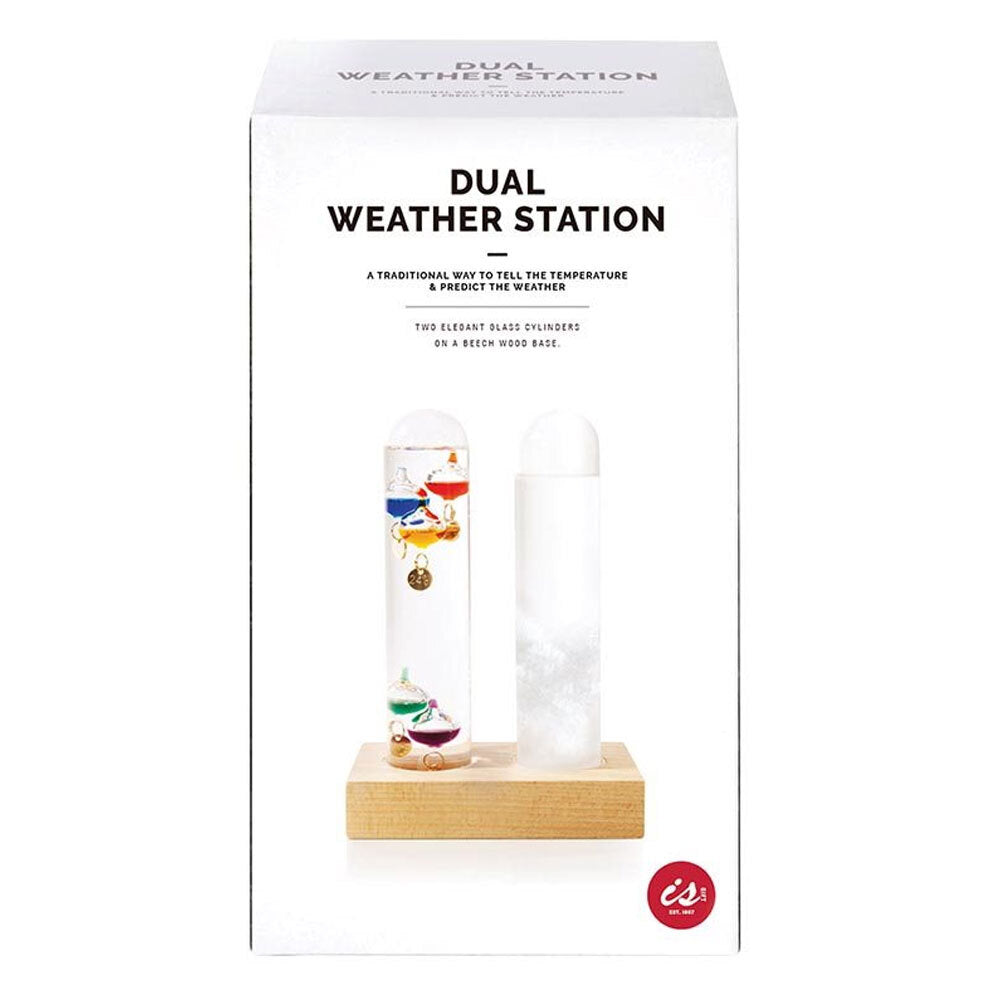
Is Gifts Dual Weather Station is a traditional way to read the temperature and predict the weather.
Storm Glass
Once used by seafarers to predict oncoming storms, the storm glass barometer came into general use in the early 1700s and responds to atmospheric fluctuations to forecast the weather.
Admiral Robert Fitzroy conducted a detailed study of this instrument between 1834 and 1836.
He refined the chemical formulation and published observational guidelines on how to predict the weather, see instructions inside.
Galileo Thermometer
In 1593, Galileo Galilei discovered that the density of liquids reacts predictably to changes in temperature. He invented a device that allowed temperature variations to be measured.
HOW IT WORKS
-
The sealed glass cylinder contains five floating glass bulbs. Each bulb has a calibrated, weighted metal tag.
-
The temperature is determined by the lowest floating bulb.
-
When there is a bulb in the middle, the temperature should be read as between this degree and the lowest floating bulb.
-
Temperature range: 16-32⁰C
STORM GLASS
SAFETY DIRECTIONS
-
In case of breakage please refer to the following. Do not subject to direct sunlight or place near to any heating or cooling vents.
-
POISON - KEEP OUT OF REACH OF CHILDREN, NOT TO BE TAKEN.
-
READ SAFETY DIRECTIONS. CAMPHOR 20.7G/230G. FLAMMABLE.
-
Can be fatal to children if sucked or swallowed. Avoid contact with eyes.
GALILEO THERMOMETER
-
POISON - KEEP OUT OF REACH OF CHILDREN,
-
NOTE TO BE TAKEN.
-
FIRST AID: For advice, contact a Poisons Information Centre (e.g. phone Australia 13 11 26; New Zealand 0800 764 766) or a doctor at once. If swallowed, do NOT induce vomiting.
PLEASE NOTE: LIQUID MAY DAMAGE SURFACES.